Monday, June 23, 2014

Frank

I realize that people who read this blog may be strangers so allow me to inform you of a poorly kept secret: I have tattoos. They are in highly visible places and have had a fairly large effect on my Peace Corps service.  

When I was applying to Peace Corps (what feels like a million years ago), they asked if I would be willing to “modify my appearance” during my service. While I like to think this relates to getting cornrows last year, it was a polite attempt to talk about my tattoos. I replied that as a teacher, I am very much used to wearing long sleeves. That seemed to satisfy my recruiter. As I packed to come here, I made sure that I had a lot of sweaters, jackets, and other items that would hide tattoos. When I was interviewed for what type of town I would want to live in for two years, I told them they better put me somewhere cold, otherwise the tattoos are coming out.

When I attend Peace Corps trainings, I try to look professional and cover up my tattoos. Once, my program director (an Ethiopian) pulled me aside to talk about how my tattoos might offend people in my town and they could never been seen.

But here is the truth about tattoos in Ethiopia: people here love them. They love them so much that I often keep my arms covered because if people see them, they want to rub my skin. Little kids will touch my arms and then look at their fingers to see if the ink ran onto them. I would wager that when I walk in Addis with my tattoos showing, someone comments on them once every two or three minutes. I recently took a trip to a hot town and while walking around, my arms were touched by a stranger every 60 seconds.

Many Ethiopian women from rural towns have tattoos as well. It is believed to help with illnesses and is always religious. The most common tattoos are small dots running across a woman’s chin line, or a cross on the forehead. Some of my favorite cultural memories have begun with comparing tattoos with 60-year-old women. All tattoos here are black. So not only are the style and placement of my tattoos completely foreign, the vibrant colors are a huge novelty.

But, there is one tattoo in particular that is my favorite in the Ethiopian context. It is the one I am so thankful I got before I came. It has brought me unspeakable amounts of joy. It is an ongoing joke with a majority of people I know. That tattoo is Frankenstein on my left forearms, or Frank, as he is lovingly referred to as. 


Why is this my favorite? Because no one here knows who it is. But they guess anyways. If they don’t guess, I make them.  And the result always brightens my day. Here are some of the people he has been mistaken for (and I 'm forgetting a ton)
Menelik II, Former Emperor of Ethiopia
Haile Gebrselassie, Ethiopian running god
Jay Z

My father
Joe- as he was standing next to me.
Zach- as he was standing next to me.
Tolstoy
Shakespeare
Meles Zenawi, Former Ethiopian Prime Minister
George W. Bush
Obama- actually 75% of the time it is Obama

Saturday, June 7, 2014

Two Years Later

June 6, 2014 marked the two year anniversary of my group coming to Ethiopia. It has been a long, awkward, hilarious, depressing, and wonderful journey. In honor of this momentous occasion, here is the first group photo of G7 waiting to board a plane to Ethiopia:


And on the last day of our close of service conference; our very last group photo.

 A lot smaller but a lot closer. In fact, probably too close.

Friday, May 23, 2014

Coffee Time!


I always imagined the end of my Peace Corps service as a relaxing time where I would enjoy and reflect on the last chapter of my adventure in Ethiopia. Turns out, I am ending my service with a sprint. Though I still have about two and a half months before I return to America, time is running out at an alarming pace. I am going to be away for the next three weeks doing (hopefully) fun things that I will be sure to report back to you with. In the mean time, I wanted to post something so I don’t feel guilty when it has been over two months with nothing for my adoring fans (and by that, I mean my mom). So, let’s talk coffee.

To say coffee, or buna, is important to Ethiopians would be a gross understatement. Buna in Ethiopia is a way a life. A tradition. You drink it when a baby is born, when someone graduates, when a couple gets married, when someone dies, and everyday in between. It is the number one export of Ethiopia and if you are a coffee drinker, you have had Ethiopian coffee. In fact, next time you’re in a Starbucks, look at the murals on the walls. There will likely be an Ethiopian buna ceremony pictured. I didn’t drink coffee prior to Peace Corps and I once joked that I was going to return to America a coffee snob. It happened. I regret nothing.

The tale of buna in Ethiopia begins in the south, generations and generations ago. A goat farmer grazed his herd all over the countryside. Ordinarily, the goats would munch on some grass and be content. But the farmer noticed, when he took his livestock to this one particular area, with this one particular plant, the goats would start acting crazy. They would suddenly become wild and unruly animals. One day, he noticed the goats were eating red berries. Assuming that was the cause of the goats acting so strangely, he took some home and had his wife cook them. They ate some and soon felt the kick of caffeine we all know and love. Eventually, people learned to process the plant to make the coffee we are familiar with today. This is the same story people tell in regards to how “chat” (a local drug where one eats the leaves to get a high commonly described as a mellower cocaine) was found. I don’t care if it’s true for one, both, or neither. It is a great story and I love it.

Today, Ethiopians drink buna multiple times a day. When a guest arrives or an important occasion occurs, it is tradition to have a formal buna ceremony. But formal or not, there is a special process to making buna. So while in America, you simply drive to Starbucks, here is how you brew buna in Ethiopia:


Step One: Wash those buna beans! They start off green and have a film over them. It is important to wash them, sort through to ensure there are no rocks pretending to be beans, and prepare them for roasting. It is common to put grass on the floor for a formal ceremony. I’m just realizing I’ve never actually asked why, but it is a sign that people are welcome in your home. 


Step Two: Roast those beans! Over a charcoal stove (yeah, just put that stove inside. A little carbon monoxide never hurt anyone), place the beans and keep them moving so they don’t burn. It is a fine line between perfection and burnt that I’m still hoping to master. 


Step Three: Heat that water! Ok, the exclamation point on that one may have been overkill. Buna is brewed in a clay kettle called a jebana. The jebana is probably the most distinguishable thing in Ethiopia. It is unique to this country and may as well be on the flag. Every home has at least one and it is my favorite souvenir I am bringing home (aside from actual beans).


Step Four: Pound that buna! Now that the beans are roasted, use a mortar and pestle to take out all your frustrations of the day. This is the part that forenjis are often allowed to do. For about 30 seconds. Ethiopians are all about culture sharing, but not at the cost of ruining perfectly good buna.


Step Five: Make that buna! Put the grinds into the jebana and let it brew. This part should be vaguely familiar. Just pretend that jebana is a French Press. I struggle with how long to let it brew. Ethiopian women have a sixth sense about it. The rest of us have to guess by the smell and steam.


Step Six: Drink that buna! Yeah, this is the best part, by far. Ethiopians put traditional stuff in their buna like sugar and milk. Sometimes though, they add butter and salt. It is not a strange as it sounds actually. During a buna ceremony (formal or not), you normally drink three of these small cups (called a sini). They use the same grinds for all three sinis so each one decreases in strength. This does not mean they get weak. The third or fourth sini is close to American strength coffee. It is not uncommon to drink 5-6 sinis of buna a day. On holidays, that easily jumps to 10-15. And don’t be fooled by the small size- it is closer to taking a shot of espresso than a shot of coffee.

This is how I became a snob. My relationship with the glorious beverage started with it being freshly roasted and brewed in front of me. There is no going back when that is how it starts. And the buna ceremony is such a sensory experience. You can see the glowing embers of the charcoal stove; hear popping as the film jumps off a bean; smell the smokiness envelop you; feel the room grow warmer; and finally, taste the product of all that work. There are some things I will struggle to adjust to in America. Buna is near the top. It is not just the quality and taste. I will miss the tradition, the feeling, and the heart of a buna ceremony. So while I’ll soon be able to conveniently go to Starbucks in America, there will always be a part of me that knows I'm sadly just getting coffee, not buna.

Monday, April 28, 2014

Earth Day


For Earth Day, my sitemate, Leslie, and I had grand plans of building a permagarden with the aid of some adorable kindergarten students. She had the know how, and I had access to a kindergarten. The only hiccup was there was no school on Earth Day because of Ethiopian Easter. Not to be detoured and deprive small children of a chance to play with forenjis, we postponed our Earth Day celebration a few days and were all set.

The idea of a permagarden is pretty simple. It is an ultra sustainable garden that can be build for a very low cost. Many environment volunteers here in Ethiopia teach low-income families how to make these gardens so they can have food regardless of income. We decided to build the garden on this particular school because it serves OVCs (orphans and vulnerable children) in the area. While they are too small to go home a build one, when parents or friends come to pick up the kids, they will see the garden and hopefully become interested. It is like we are planting seeds in people’s minds (see what I did there?).

So allow me to walk you through the cutest training I will give in Ethiopia…

Leslie explained how to “double dig” to the adults at the school. It took some explanation, but eventually they got it. Unlike the kid in red on the right, he understood instantly.

Some of the students looked on in vague interest.

We realized we needed to go buy charcoal, so Leslie left me for 10 minutes. She said to make sure they finished digging. Instead, I took on 12 kindergarten students in a game of football. It may have had something to do with the fact the goal was about 4 feet across, but I dominated.

After football, I was hot and had to take off my fleece jacket. Thus began the tattoo routine. Yes, they are permanent. No, that is not Obama, etc. I love my little buddy in red’s reaction.

We needed to break the charcoal into powder, so we had the kids stomp on it. While this was not an effective method, it was pretty cute.

Once the plot is dug, you mix wood ash and charcoal powder into the soil. This absorbs and retains water so the garden is fruitful year around. Here, the students grabbed one handful of ash each.

And they joyfully threw their one handful of ash. I think it was the most fun they had ever had a school.

Leslie mixed the ash, charcoal, and soil together.

Leslie passed out seeds for the students to place in the ground. We planted four different vegetable that will hopefully turn out well.

Our finished plot!

Since the students didn’t learn much from the gardening portion (except 1. Throwing ash is fun and 2. Laura is a football god), we brought them inside for a classroom activity. The students learned Earth related vocabulary and then colored some pictures.

This little man could not figure out what we were doing. He was clearly younger than the rest and extra adorable. I’m pretty sure after a while he knew he was suppose to be coloring, but was just too cool to do so.

I stayed in between the lines and everything!  

The class with their finished worksheets!

Thursday, April 24, 2014

My Last Ethiopian Holiday


It is said that on Ethiopian Easter, or Fasika, some two million animals lose their lives in this country. As someone who spent years of her life not eating red meat, I feel it is the perfect place to make up for lost time.

I love Fasika. And I don’t love it in a Peace Corps sort of way. I don’t eagerly wait to see displays of culture. I don’t use the holiday as an opportunity to discuss the similarities and differences of America and Ethiopia. I don’t even particularly consider the religion ramifications of the day and how they relate to me. I love Fasika because it represents everything that is right in the world. Family, friends, and communities come together to eat, drink, and be merry. Every Christian home is full of food and everyone is welcome. Myself and other volunteers routinely receive countless offers to come into people’s homes and eat as much as humanly possible. People go from house to house in their small neighborhoods to create the best “crawl” experience in history.

One of the major aspects that make Fasika so special is the months leading up to it. In the Catholic faith, there is Lent. You give up something to show your devotion. In Ethiopia, what you are giving up is picked for you. For all Orthodox Christians (probably 50% of Asella), there is a 55-day fast. People are not allowed to eat any animal products for that period. In essence, they go vegan for two months.

Side Note 1: Ethiopians love meat. If you ask someone what their favorite food is, they will likely respond with chicken stew (called doro wat). Milk in coffee is a wonderful addition and the average Ethiopian drinks coffee three times a day. Most Ethiopians love to put butter in everything. Seriously, everything. It is a hair product here. To take all of that away from people is a serious hardship.

Side Note 2: The one advantage to the Fast is the vegan food here is incredible. There are such delicious dishes that don’t need meat. Lentils, chickpeas, kale, potatoes, are all cooked to perfection during the Fast because people are desperate for tasty food.

The Saturday before Fasika, I made plans to go to a large animal market filled with thousands of goats, sheep, and cows. Abel, Leslie, and I met at a coffee house near the Asella bus station. Ordinarily, being near the bus station results in a lot of unwanted attention. This day was completely different. There was an amazing atmosphere in Asella. Everyone was happy knowing tomorrow would be the big day. As I was walking to the coffee house, I ran into a Rastafarian who I have a bit of a history with. He has been known to yell rude things and follow forenjis all around town. On this day, he said hello, asked how I was, and then wished me a happy day. As we walked to the market (maybe 25 minutes), everyone was in a festive mood.

The animal market itself was a great time. I went last year before Fasika and it was mass chaos. This year was much more orderly. They had specific section for different types of animals. People showed off their livestock with pride. And, just like last year, eventually Abel and his brother Dagim separated from us to get a fair price. As Leslie and I waited for them, an older man tried to sell us his best sheep. A fair price for the animal would have been around 2,000 birr ($100), but he was willing to part with the animal for the low price of 4,000 birr. What a steal! Sadly, Abel and Dagim found the winner (or loser from its perspective) before we could jump on the opportunity.

Later in the day, Leslie and I headed to Abel’s house for the beginning of the celebration. In the time since we had parted, they had proceeded to kill and completely butcher the goat. Abel made delicious t’ibs (small, bite-sized pieces of meat) cooked with onions, pepper, and all sorts of spices. It was delicious and the best meat I had eaten in months (and that is a true compliment because I cheated often by eating meat during the 55-day fast). We stayed late into the evening and enjoyed a few cocktails. Abel recently went to visit his brother in Dubai so we were able to see pictures from his trip. Dubai seems weird. There is so much money there that the police drive Ferraris. I wouldn’t have believed it unless I saw the pictures. It was a great night filled with a lot of laughter and food- I couldn’t have asked for anything more.

At 11:00am the next morning, it was my landlady’s turn. She had prepared a mass amount of doro wat. Doro wat is one of my favorite foods. Not just in Ethiopia, but ever. This doro wat was made extra special because I had a strained relationship with the chicken in it. He lived in a coop right outside my bedroom window and had been waking me up at 4:00am every morning for a week. I was not sad to see him go. In fact, my only regret is that I was not the one to kill him. But doro wat is ridiculous. It takes a day to make. For every chicken, the recipe calls for 3-5 kilos (7-11 pounds) of onions. You let onions, garlic, ginger, and all sorts of other wonderful ingredients stew together until perfection. It is served with the onion base, a large piece of chicken, and a hardboiled egg. Faven piled my plate high and I was happy to take it down. We had coffee together and then I took a holiday nap.

In the early afternoon, the married couple that used to live in Asella called to wish me a happy Fasika. Joe, being the loving gentleman that he is, preceded to tell me everything he had eaten for Easter breakfast. He ended his rant with, “we ordered so much bacon, we actually just had to leave some on the counter to be thrown away.”  He went right for the jugular. On any other day, this would have been painful. But I instead told him of the doro wat I had just eaten and that I was heading to Tilahun’s for dinner. Both he and I know Tilahun’s cooking is better than all the bacon.

Tilahun’s cooking is always a treat. He is the best chef I have ever been lucky enough to eat from in my life. I have no doubt that if he opened a place back home, it would be all the rage. I eat at his house on every Ethiopian holiday. When my parents came to visit, he cooked an amazing feast and made special dishes for my mom since he slyly found out she loves lentils. Every time I am there, it is the best meal ever and Fasika was no different. He prepared a comical amount of food. When we arrived, we were given bread and homemade butter he had decided to make. The meal itself was incredible. He made some of the best t’ibs I’ve ever had. The doro wat was so flavorful and the chicken was tender. He had homemade cheese that somehow made the doro wat more rich and delicious. And finally, he made his world famous dulet. I don’t want to like dulet. Whenever I think about it, I immediately stop believing that I like it. Dulet is the intestinal lining of a goat or sheep cooked with spices, onions, peppers, and everything else that is good in this world. Oh, and it is usually served “rare”. I don’t want to like it and if I eat it anywhere else, I don’t. But then I take a bite of Tilahun’s dulet and he converts me again. The night ended with Leslie and I reading a story with Tilahun’s daughter Soliana, and, eventually, her falling asleep on me. It was a perfect way to end a perfect holiday weekend.

I guess the take away of this entry is simple: there is just no reason to be vegan. Occasionally, vegan food can be prepared well and makes a great meal. But to live that lifestyle forever is silly. Really, it’s just silly. If you are vegan and reading this and getting offended, that’s fine. If you had a proper diet in your system that included meat, you would be able to think straight and see that I’m right. Meat is good. And you know how I know that without being subjective? Tofu or the Ethiopian equivalent, Tasty Soya! If meat were bad, there would not be horrendous attempts at substitutions. The only way I made it through the Fast was by remembering that it would end in a glorious celebration where two million animals sacrifice themselves for the good of mankind. And after all, isn’t that what Easter is really about?

Wednesday, April 9, 2014

Tanzania!

The second portion of my parents’ trip was an amazing safari in Tanzania. They would see romantic landscapes, sleep in luxurious tents, and witness some of the most awe-inspiring sights the world has to offer. So naturally, I invited myself.


Peace Corps has a program in Tanzania so I expected the country to look and feel much the same as Ethiopia. That was a naive viewpoint and proved how little I have apparently learned by travelling. Tanzania is a poverty stricken country but has utilized their natural resources to create a growing economy greatly based on tourism. As a result, many of the places we travelled catered to western visitors and it was obvious the money was pouring in. Ethiopia has some incredible sights and activities for tourist, but Ethiopians have not learned to take advantage of them properly. Recently, there has been a trend where Ethiopia is becoming a hip place to visit- here’s hoping! But for now, when you think of African vacations, you probably think South Africa, Kenya, or Tanzania.  

When we arrived, our game driver was waiting for us with every aspect of our next 6 days planned. Over the course of the week, we went to Tarangire National Park, Manyara Lake, Serengeti National Park, and the Ngorongoro Crater (the single most underrated place on this planet). It was a full schedule but allowed us to see everything.


The country was lush and green. The rainy season was just beginning to start, which made for some pretty epic landscapes


But let’s get down to it. People usually go on safaris to see animals. I was talking to my Peace Corps Ethiopia Country Director about the trip before I left. As a man who has spent decades of his life living and working in Africa, he has been on more safaris than he can count. He told me the first is always special in an indescribable way. He set the bar impossibly high because this man is a talker and has never been unable to describe something in the two years I’ve known him. But he was so right. I knew I would enjoy the trip, but I couldn’t imagine how much.

If you have a bucket list, put an African safari on it. I was extremely fortune to be able to tag along with my parents, but it showed me that seeing wild animals in person is something every person should strive for. My mom and dad embody this. My mom had a lifelong dream to go to Africa to see animals. Looking back, I think that is why she forced me to join the Peace Corps and move to Africa. When we saw the first animals, she was overcome with emotion. This was a dream decades in the making and there we surreally were: in the middle of a herd of 40 elephant or looking a lion in the eyes. My dad coming into the trip, on the other hand, was something a step above indifferent. He was excited, but he is more of a beach/water type of guy. Yet if I had a quarter for every time he was speechless because of a sight or could only manage to say the words, “this is unbelievable” or “this is just too amazing”… I don’t know how to finish that sentence. I’d have a lot of quarters, I suppose.

During the safari, we were lucky with both the weather and the animals we saw. Looking at the photos, I still cannot believe we were so close to some of those animals. I think we saw them all. Like literally, all the animals in Tanzania. The Big 5, 25+ lions, hundreds of zebras, scores of elephants, and so many other things will always live in my memory.

During the 6 days, we saw so many zebra. My dad asked the astute question of, "why didn't zebras get domesticated like horses or donkeys?" The guide didn't have the answer, but I agree with Norm: walking by zebras carrying loads of water or sticks would be enough to make me never leave Africa.
Warthogs are the unsung heroes of Africa. We spent so much time just watching these adorably ugly creatures play.
I feel like giraffes are the hipsters of Africa for some reason.
While we saw tons of elephants, the highlight had to be when we were in the middle of a herd of forty. It was incredible to watch them interact. The age range was babies to decades old and they truly behaved like family.
The elusive rhino!
Hippos running out of water is one of the funniest things a human can witness in their life.
I got heated when talking about hyenas. We have them here in Ethiopia and they will kill a person. No one seemed super alarmed by them, especially as one walked 5 feet away from me as I was eating dinner. I argued they are scary and Tanzanians responded by telling me stories of hyenas eating other hyenas and how unstable they can be. They kind of just proved my point.
The two above photos are the same lioness. She was watching the three hyena to ensure there was no funny business. As she walked from the fallen branches and climbed up the tree, she was maybe 3 feet away from our car. As she sat in the tree, she was easily close enough to jump in the open car. She looked us right in the eyes and didn't care. Probably one of my most humbling experiences.
Another time, we saw a herd of 10 lions feasting on a buffalo.
It was a hot day and the only shade around was that created by our car. When you don't have to use zoom to take a picture of a wild lion, you know you're impossibly lucky.
This is a jackal. They're adorable. They weight maybe 15 pounds and are scared of everything. I want to get my dog, Tobey, one as a pet. 

Overall, the safari portion of the trip was just incredible. It was such a privilege to be able to see such exotic animals in their element. There is a recognition that goes along with being that close to wild animals. It makes you realize how inspiring nature can be and how much it should be protected. It gives you a feeling no zoo will never be able to capture.

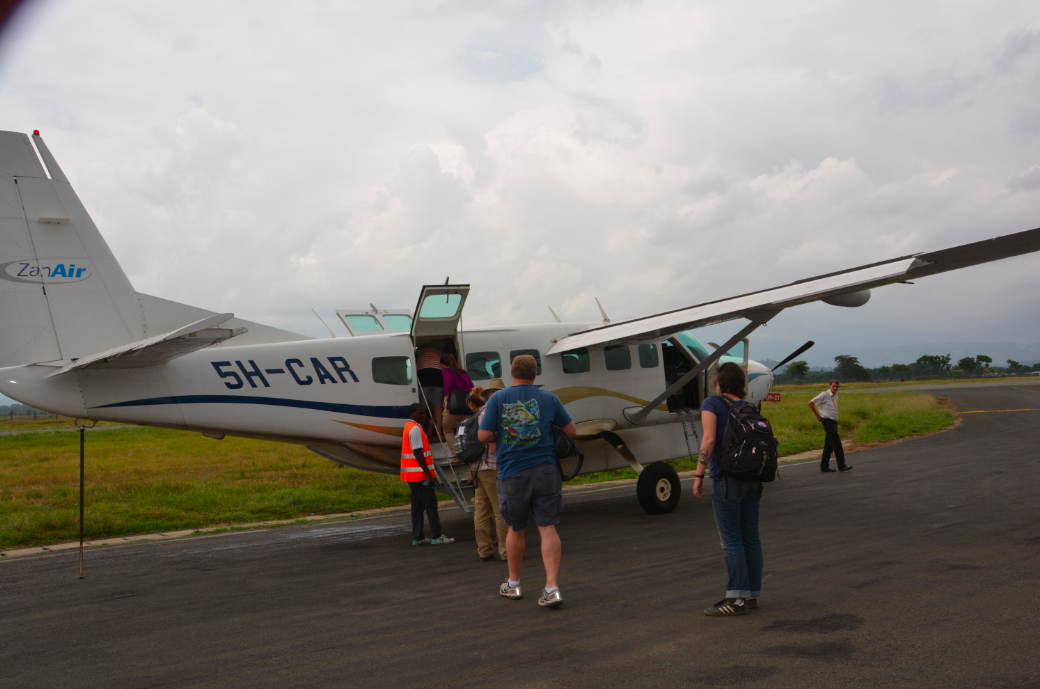
The last leg of our trip was a few days beachside on the island of Zanzibar. I never realized how much I loved the ocean until I moved to a landlocked country for two years. Zanzibar is a large island off the coast of Tanzania. The two merged into one country decades ago but still operate separately. From Arusha, we boarded a tin can that had wings. To say that I did not enjoy the flight would be an understatement. I am not sure I breathed the entire time- I was too busy waiting for the plane to crash.


The time spent on the island was full of relaxation. One day, Norm went SCUBA diving and my mom and I went on a tour of a local spice farm. But otherwise, we just enjoyed some beautiful scenery, amazing and endless food, and delightful company.


A good time was had by all.